Circle Complete
Our final leg to the Caribbean
Passage: Monday, Nov 17 - Friday, Nov 28th, 2025
Click here for Caribbean page: https://www.oceansfive.net/caribbean-home
This final passage of our world journey is a combination of bittersweet and enough already, let’s get this thing done! I know not being able to fly home to meet our new grandson plays into the sense of urgency to return home.
After a couple days at sea, we receive another, unexpected courtesy call from a passing cargo vessel. He asks how the sailing’s going and where we are coming from. Rob responds telling him we’re great, on our last leg of a circumnavigation. He responds with a chuckle, calling it “suffering around the world,” instead of sailing around the world. Maybe because his speed is twice as fast as ours? The jovial jab aside, we appreciate him checking on us.
By Thursday, we are in the current everyone called The Magic Carpet, part of the Southern Equatorial Current which runs from east to west, north of the coast of South America.

On Friday, we continue to sail the wing on wing formation, an 18 knot wind behind us, cruising along at 10 -11 knots, feeling like we’re going half that speed. Apparently, wahoo prefer bait traveling fast because the reel screams; Rob pulls in our first wahoo ever! He doesn’t fight as we would expect a wahoo would, but he looks healthy. We enjoy him for a couple of dinners. Apparently, we could use more practice cooking wahoo because they’re very easy to overcook. In hindsight, sushi or ceviche would have been a better route to go.
Saturday, the radio blares with someone saying something we can’t understand. We assume he’s calling us because the transmission is loud and clear and no one else is around. Rob responds and they have an English speaker reply. Ahead is a cable laying vessel researching the ocean floor for gas and oil. He instructs us to stay 3 miles clear of them on their port and starboard sides and 7 miles clear of their stern. When we reach them, it is dark and we can see the main vessel with its two support vessels. About 500 yards behind the main ship, periodically the sea flashes with light emanating from far below the surface of the water. The ocean is thousands of feet deep here. Would they drill for oil this far out? A few days later, we find the answer. An enormous oil platform, lit up like the Rockefeller Center Christmas tree, sits in even greater depths. Three other tending vessels hover around it.
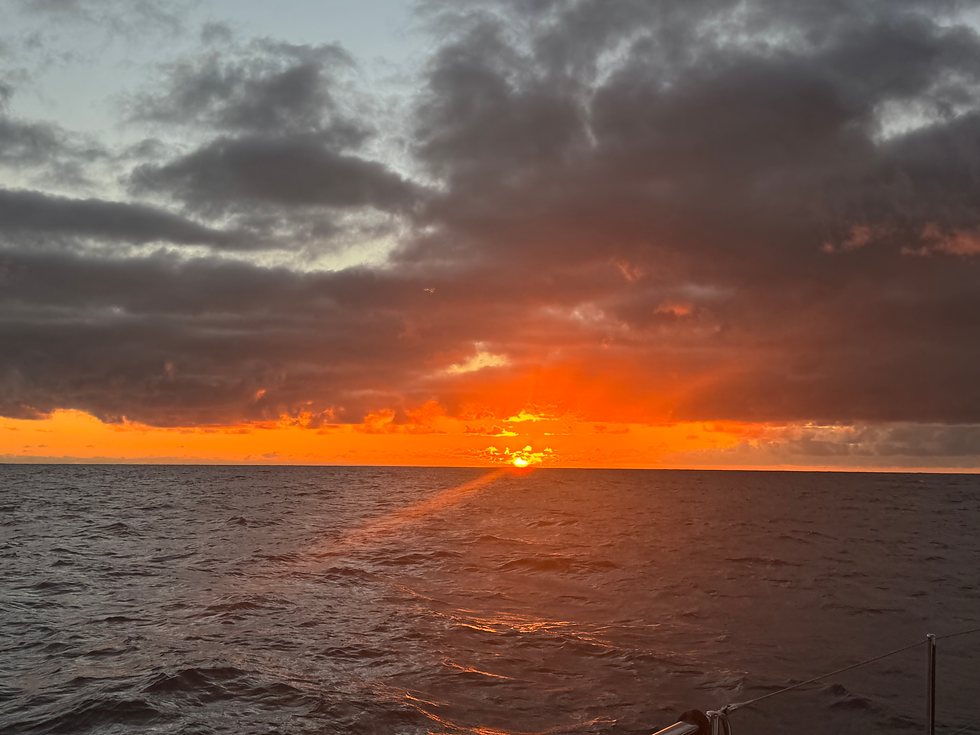
Tuesday morning’s sunrise is gorgeous. In the orange glow on the water, dolphin’s fins pierce the reflection from the sky alongside Jolie. A sunrise on the ocean casts its glow 360 degrees. In every direction, the orange glow reflects off the taller clouds. This is partly why it feels so magnificent out here. It engulfs the entire horizon. I’ll miss greeting the mornings on the open ocean with their vast, unimpeded views in all directions. I keep trying to take photos, but I’m unsuccessful at catching the fullness, richness of the experience. I’ll also miss the solitary night watches. Parts of it I won’t miss at all, especially when the weather’s sketchy or a cargo ship is passing far too close. However, the night sky, a plethora of stars, a moon which may or may not be present, inspires an almost primitive connection with the earth. I can’t really describe it except to say I know I will long for it when I’m home.
Later in the day, we pass out of the current and the winds lessen. We bring in the Yankee and Main sail. Rob and Neil head out on the bow and raise the Helix for the lighter winds, as we continue downwind.

Then the wind changed direction - a beam reach - so down comes the Helix. We continue with the Main and Yankee in a splashy, sporty sail on a fast, starboard tack. Winds are 18-24 knots, which is a decent amount, but we miss the added speed the current contributed.
On my Wednesday morning watch, the sun beginning to peer above the horizon, all the nav screens alarm and stop working, including autopilot, gps, etc. I quickly grab the helm and knock on our bedroom hatch (conveniently right behind the helm) to alert Rob. Fortunately, we have the old fashioned magnetic compass in the helm so I’m able to use it to maintain our heading at 312 degrees. We also have a pretty forgiving sail formation with the beam reach we’re on, so I don’t have to worry about gybing or tacking easily. Rob worked on the electronics for about an hour and a half (thankfully, he’s really good at problem solving in many varied situations). He determines another Triton screen down in the nav station isn’t working correctly. After removing it from the system and restarting all the instruments, everything appears to function as it should. We are only about two days out from our final stop, but it’s really a relief to have all working as it should. Hand steering is tiring, but not having the wind information, AIS to tell us where other boats are and to alert them to our position, depth information, etc is scary.
Speaking of scary, on Thursday night, our last night before reaching Les Saintes, during my watch, the winds pick up on an already moderately rough sea. The combination of a larger wave with the 28 knot wind kicks off the autopilot. I grab the helm wheel, and try to correct back to our set compass heading. However, as I look down to check our wind angle, we are turning too close to the wind. Afraid the higher winds may make it too hard for me to control the boat, I begin turning down wind hard and fast. We are hit with another large wave which rotates the boat again. At this point, I’m really disoriented and uncertain which way to turn. It’s disorienting at night when there’s no moon and no visual reference point outside of the boat - only deep blackness. And with the sails up, I’m really worried about gybing. I’ve over-corrected and as I look at the wind instrument screen, I see the boat rapidly turning. Too fast and too far. Yes, the boat gybes. First Rob, then Dave and then Neil appear up in the cockpit. Rob rushes to the other helm, which I’m very happy to surrender to him, and corrects our heading. Thankfully, the gybe preventer, a very strong dyneema line attaching the end of the boom to a cleat at the side of the boat, held. This line prevents the boom, with the tremendous forces of the mainsail, from accelerating across the stern of the boat and damaging lines, rigging, sails, people. It’s a very dangerous situation. I’m shook up and a bit embarrassed to have made what feels like a panicky, rookie move on our last night of circumnavigating the whole flippin’ world. Humbling. And a lesson well learned as I play out in my mind exactly the procedure I’ll follow in the future. Rob’s sweet and tells me it’s his fault since there was too much sail out for the amount of wind. But I know the responsibility lies with me.
On Friday, November 28th, around 10:30 pm-ish, we arrive in Les Saintes, Guadeloupe!

This is the completion point for us because we came here after Antigua in order for Calvin and Ellie to see the area. It is from here, we officially started our circumnavigation toward Bonaire back in January 2024. After the anchor is secured, the four of us sit down in the cockpit and have a celebratory beer and take a deep breath in.

A really satisfied, full feeling settles upon us. It’s hard to believe we’ve officially completed the circle. Our rally friends who’ve been following our progress begin sending us congratulatory texts, one after another, from almost everyone.


These past two years have been some of the best and worst of our lives. We are so grateful and overwhelmed to have been part of this adventure. And to have been able to complete it after Rob’s cancer and treatment. Life is so very good. Now, let’s go home and meet our new grandson!!!


Comments