The Vast South Atlantic Ocean

Return to Cape Town and Beyond….
Passage from Cape Town to St Helena: October 8-18th, 2025
St Helena Island: October 18-29, 2025
Check out the St Helena webpage at this link: https://www.oceansfive.net/st-helena
Rob and I fly back to Cape Town on Saturday, September 27th, 2025. I believe everyone reading this likely knows we were home January through September for Rob’s cancer treatments - surgery, chemo and radiation. I don’t think this is the place to delve into that time. However, I would like to say, Rob was extremely well cared for at MD Anderson in Houston. We highly recommend it for cancer care. His every need was anticipated, from pain and nausea management to nutrition and mental health; we were as prepared as we possibly could be for his care plan. And, as I watched Rob go through the treatments (torture, really) he received, he did it with unwavering courage and grace. Brings tears to my eyes just thinking about it. And there wasn’t a moment throughout where his plan faltered… He wanted to return to Jolie and finish our circumnavigation. Hence, after his second routine 3-month check-up in September was clear, we knew we had 3 free months before he had to return to MD Anderson. We’re going to Jolie!!!
We had the peace of mind knowing Jolie was being well-cared for by Geoff, who was the captain of our sister vessel, Altaia. He lived in Cape Town and our time at home coincided with him wanting to stay in Cape Town. Also, Carsten and Martina (Altaia’s owners) graciously gave him extra time away from their plans with Geoff so he was available to help us out. Lovely, thoughtful people. This was important to give Rob the ability to really focus on recovering without worrying about Jolie and the plethora of issues a boat docked at a marina for 10 months can develop.
From our arrival to Cape Town on September 28th, we miss our Oyster Rally family. Above all, we are very grateful to have the good health and, thus, the opportunity to be back here to complete our journey. However, they leave a big hole. Our boats lined up together at the dock, chatting in passing or as we’re hanging laundry on our lifelines, planning day trips and restaurant rendezvous, working on boat repairs together, running into one another around the shopping complex. Many great memories of mundane, little things, to expansive, unsurpassed, shared experiences. Good stuff.

Our week before departure focuses on getting the boat and ourselves prepared. It’s unseasonably chilly in Cape Town for October. As Rob looks at the weather, it will be cold all the way to St Helena and beyond. Time to shop for cold weather garb - puffy jackets, gloves, scarves, hats, fleeces, sweat pants. And without our previous crew, Ellie and Calvin, I take up the role of provisioning and galley wench. After leaving Jolie, Ellie and Calvin moved on to crew on RiRa. We will miss their energetic personalities, but are also looking forward to our new crew. Dave is a calm, quiet, kind British man from Bristol and was captain on Sydney Rock, an Aussie-owned Oyster, and has joined us as a deck hand. Neil is Mike (s/v Distraction) Hutchinson’s brother-in-law, who sailed a portion of the rally on Distraction. He and Mike were kindly both planning to join us on this leg, wishing to help us complete our trip. As the time approached, Mike realized he couldn’t join us. However, Neil was game. He’d sailed from Cape Town to Recife, Brazil on Distraction and felt happy to repeat that portion and more, all the way back to the Caribbean. Neil is originally from the Channel Islands and currently lives in Cornwall. His lovely wife, Nic, flew to Cape Town with him with plans to explore the area and check out the safari at the beautiful Kwandwe Reserve. We tentatively planned to join them, but hesitated making reservations since Rob wouldn’t have the doctor’s approval for us to return to CT until his appointment in late September. We’d already gifted the full cost of the safari back in January to another couple (Penny Oyster) when we had to cancel at the last minute and return to Orlando. And, honestly, it felt somewhat surreal to be back on Jolie. I felt content to embrace the ordinary boat chores, cooking prep for the passage, shopping and simply absorbing the fact we were back here. Watching Rob falling easily back into Jolie mode like we’d been home for a brief holiday and simply returned to South Africa to carry on, felt almost like a miracle. Life is good and we are blessed. We are grateful he continues to make an incredible recovery.
Farewell Cape Town:
We said our farewells to Nic on Monday. On a sunny Wednesday around noon, October 8th, Geoff casts us our dock lines and we finally chugged our way out of the V & A Marina.
St Helena Island, here we come!

Our first passage of the three we’ll be making to return to the Caribbean will take about 10 days and 1700 miles (actually more since we have to travel in the direction the wind takes us which is rarely a straight line to the final destination). There’s no transition for us back into the cruising life - we’re thrown right into open ocean passage and all the beauty and uncertainty it holds. We’re praying Jolie is properly prepared for the challenges ahead. She’s been great through the rally, but the long 10 months sitting in the marina give us some pause.
Our first day out, we are reminded of God’s overwhelmingly vast creation. Nature greets us with open arms. The presence of humpback whales in the distance, their steamy spray as they exhale. Rob spots one breach directly in front of the boat. We rush over to watch, only to have it disappear in the deep without another sign. Later in the evening, after the sun set, before the moon rose, it was really dark as I sat alone on my watch at the helm. The small amount of light from the chart plotter reflected palely on the white break of the waves around me. I noticed streaks of white under the water passing in the opposite direction of the white water of the wave breaks. Am I seeing things? As I watched, these streaks accelerated past the boat and some cut underneath the hull below me. Dolphins!! Their paths glowing with the bioluminescence in the water! I think dolphins are kind of magical anyway; this was really amazing. I know they weren’t, but it felt like they were welcoming our return, telling us to “Come on! Let’s do this!” Not to be outdone, the horizon over my right shoulder began to glow orange. Slowly, a massive, brightly shining, full orange moon lifts above the horizon. Rob is about to relieve me on my watch and I call him up. We marvel at the beauty of this moment, and really the whole day. We are actually here, back doing this crazy thing we’re doing. And God’s fingerprints are everywhere out here. It feels like He’s blessing our journey - sending this message through His creation of critters below the ocean and His expansive night sky above.
Thank you, Lord, for giving us this time to finish our sailing journey. I wonder what He has in store for us?
We are reminded of the power of the elements on Day 2 and 3. The seas begin to throw some large swells and higher winds (25-35 knots). We’re sailing downwind and it’s been quite rolly, with the occasional larger swell throwing the autopilot off - combination of higher winds with larger swell too much for the autopilot to compensate. Maintaining a close eye on wind angle, wind speed, rudder response and swell, help to indicate when the autohelm might cut out. Our 2 1/2 hour shifts feel long. However, by Friday morning, the swells settle some, the sails are set and Rob has the autopilot set properly to respond to the stresses placed on it. Happy sailors all around!
On Day 4, October 12th, the winds have really died to the point we must motor. I’m okay with it - nice contrast to the hectic past days. Rob’s even able to grill steaks out on the barbie! As the sun is setting over a calm ocean, reflecting orange across its smooth surface, I see the black back and small tapered dorsal fin of a humpback, breaking the orange surface, along with the blast of mist as it exhales. We all jump up to watch the graceful progression of two whales, moving between us and the setting sun. We gaze in silence, taking in the rare beauty of the scene. I’m reminded again of the sense of feeling completely immersed in God’s magnificent creation. Pinch myself.
The night sky proves to be every bit as beautiful as the sunset. Half moon brightly illuminating the sparse puffs of white clouds and lighting a path on the ocean surface between Jolie and the moon. Stars are visible, unlike with a full moon. Innumerable stars. The air is chilly, but not quite as biting. At night, I’m still wearing multiple layers under my offshore gear, along with fleece hat and gloves.
Highlight of the next day is a mahi! Neil pulled it in and cleaned it. They’re gorgeous when you first reel them in - bright, glistening shades of blues, greens and yellow. As life fades from them, their colors do as well.

Thursday, October 16th. As the weather warms, the short-sleeved days are welcomed. We’ve now settled into our daily routines. We need to appreciate when a day feels a bit banal. Because life on a boat is often interrupted by something breaking. This passage began with aft refrigerator issues, which were repaired in CT. Then, once it was up and running, the forward and cockpit fridges both kicked out. Then, magically, they both started working. For now…. This morning, after a very rolly night, I stepped into the galley to note the oven was askew. After closer inspection, one of the bolts of the gimbal had sheered off. This is really a problem because the gimbal is what allows us to cook on a horizontal stove. Without it, pots and pans (and their hot contents) would slide onto the floor or whatever poor soul is standing there. Rob believes he ordered spare bolts last year, but where to find them? For some reason, he looks in the nav station desk and finds them straight away! So, that never happens. We often search inside the base of the couches, in the storage compartments under our mattresses, etc. This was a pleasant surprise. After almost two hours of labor, Rob and Neil manage to repair the stove. Phew!
St Helena Island!
On Saturday, October 18th, we finally arrive to the British Overseas Territory of St Helena Island. At 5:15 am, we have the first sight of a tiny light on the horizon far in the distance. As we sail closer, the several lights which appeared at water level are actually up on the mountain. Rob says it’s due to the curvature of the earth. Who knew?! St Helena juts out of the ocean in tall, jagged, grey volcanic cliffs - very stark with almost no visible vegetation and the only appearance of humans is the several flashing navigation lights. As we motor around to the northwestern side of the island, we begin to see indications of life. A small town, Jamestown, is where we plan to anchor. It rests in a valley. On one side of the valley are tall, sharp cliffs of volcanic rock. On the other side of the valley, the lava rock is a rusty brown color, resting in convoluted layers, kind of like a giant cow pie. We are to learn, in many ways, this is an island of contrasts.
We anchor in the bay in front of the largest town on the island, Jamestown. We lost two hours on the clock before arriving and now have about 8 hours before we are to meet with customs officials. Good opportunity to give Jolie a much needed bath. After a long crossing, salt water crystals encrust every accessible nook and cranny on the exterior, while the interior of the boat becomes surprisingly dusty. After lunch, the water taxi, with its jovial, grinning driver, Chester, picks us up and brings us around to Rupert’s Bay where we meet Nicky, the Harbor Master. We proceed to have one of the easiest, most friendly customs and immigration processes of anywhere in the world! After Nicky (btw, he’s a big, dark skinned man, not a female) finishes checking us in, he drives us over to immigration and waits until we’ve finished, in order to give us a ride over the mountain and back into Jamestown. Chatting away as he drives around very steep, curving, narrow roads, he tells us about Jamestown and where to grocery shop, eat out, etc. He warns us we may get tired of smiling and waving to people, but to expect everyone to extend these courtesies to us.
Jamestown is nestled in the valley between two steep volcanic hillsides. The valley is very narrow toward the interior and opens up as it reaches toward the ocean. The town itself fills the base of the valley as it spills ocean ward. There are no buildings up the hills on each side. Rather the cliff sides are stabilized with an extensive chain link mesh system to prevent rocks from falling on the town. St Helena Island is only 47 square miles and is considered one of the remotest islands on Earth. With a population of just over 4,000 people, it’s quite sleepy. About 115 people live in Jamestown, while the rest of the population is in other villages around the island. Half Tree Hollow is another town/residential area sprawled along the high plateau overlooking Jamestown. There is a very long, precariously steep, cement staircase connecting Jamestown with Half Tree Hollow. Deemed Jacob’s Ladder, we feel we must take the challenge and climb the 699 steps to honor our son, Jacob. Ugh. This is a really steep climb with very tall steps.

Definitely not to code in Florida. We check it off our list the next day. Sitting on a boat for almost two weeks doesn’t prepare one well for such endeavors. However, we were rewarded with a gorgeous view from the top of the steps, of Jamestown and the bay, dotted with anchored boats. The scene was complete with white fairy terns sweeping through the air below us. Lovely. Now to walk back down….
On Sunday, we have the pleasure of meeting Neil’s friends who are living on St Helena. Neil is a retired veterinarian and his friend, Andy, is the same. He and his wife, Alice, are living here while he fulfills a three year contract as the island’s veterinarian. They are from Orkney, Scotland and are two very warm, interested, lovely people, thoroughly enjoying their adventure living in St Helena. One of Andy’s duties as the local vet is to feed the famous land tortoise, Jonathan, at the governor’s house. What makes Jonathan so special is he was hatched in 1832, which makes him 193 years old.
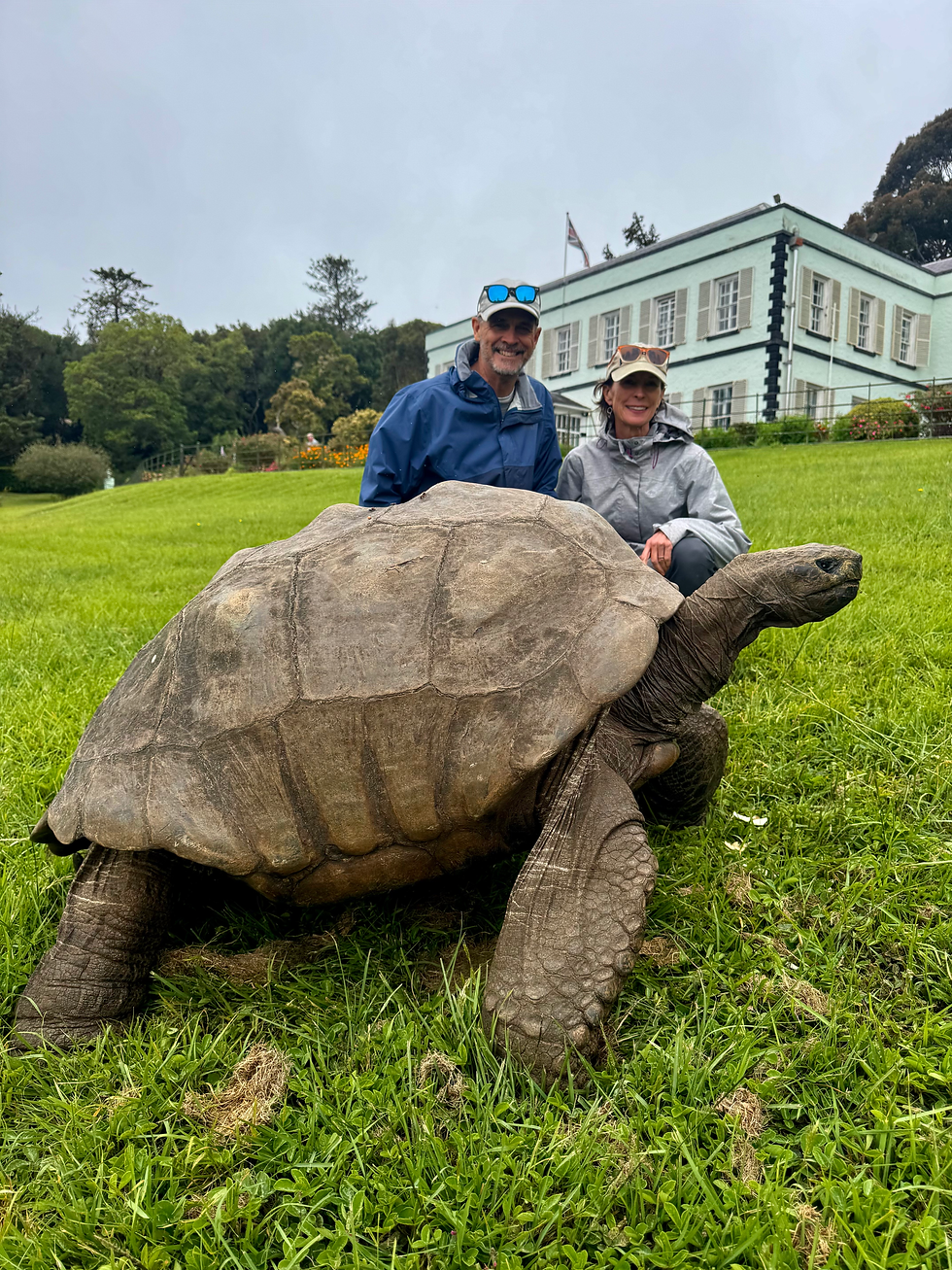
He is considered the oldest living land animal in the world! We have the pleasure of accompanying Andy and Alice as they feed Jonathan and his younger friends, Emma, David and Fred, as they roam a large, grassy fenced in area in front of the governor’s house. At this point, poor Jonathan is blind, but he had no trouble eating the fresh veggies Andy offered him. It’s hard to believe Jonathan came to St Helena about a decade after Napoleon died here in 1821. After the feeding, Andy and Alice invite the four of us back to their home for lunch. They’re renting a beautiful home up higher on the island which is surrounded by coffee trees, part of the Rosemary Gate Coffee Estate. The beans are a green tipped Bourbon Arabica Coffee, introduced to St Helena from Yemen in 1732. Interestingly, Neil said these beans are sold in London at Harrods. As we ate on their front porch, we noticed the air temperature is significantly cooler than down in town. Alice tells us it’s a cloud forest up there; many days have a misty cloudy phase. The grass and plants grow normally up here, unlike the barren rocky terrain around Jamestown.
Sadly, the population of St Helena is declining. Many of the young people choose to move to Ascension Island or the Falkland Islands where they earn better wages. One evening out at dinner, we spoke with the principal of the high school. He said there used to be a scholarship program available for good students to attend university in the UK, with the stipulation the student return to work in St Helena for 5 years. However, the governor decided to discontinue this program. Why? Sadly, for most of the kids, there is no further option for a formal education after high school, except online.
On Monday, Neil rented a little Hyundai. We rattled around the island on narrow, curvy, steep, bumpy, often single lane roads, some with very steep drop-offs along the edge. Neil explains how for years he’d whip around little country roads zooming to the rescue of animals he tended in his vet practice. From the back seat with me, Rob anxiously reminded him several times we’re not in any hurry. During our exploration of this small island, we begin to realize the vast contrast in the landscape. From the stark, barren, void of any plants, landscape of lava rock, to rolling green pastures dotted with sheep and cattle to rich, tall forests with enormous trees, including eucalyptus. The scenery is stunning. All crammed in this 47 square mile island.
The area is also very rich in history. Because of its location - the only stop in the South Atlantic Ocean, it became a very popular destination for trades. It was originally stumbled upon by the Portuguese in 1502. Later, the East India Company was granted a charter to govern the island from 1657, where it was used as a stopping point for their ships traveling from India to the UK.
In 1834, the island was transferred to the British Crown and is now a British Overseas Territory. Without a doubt, the most famous resident of St Helena was Napoleon Bonaparte, who was exiled there in 1815 after his defeat at the Battle of Waterloo. He died there in 1821. The island was also a crucial stopover for the transatlantic slave trade as the ships traveled from Africa to the Americas. There are many tragic stories surrounding this era, including the island being used as a quarantine site for liberated slaves captured from slave ships during abolition. An estimated 27,000 of these freed slaves passed through St Helena. This sounds positive, but more than 8,000 of them died due to disease and malnutrition. Tragic. The island is steeped in history which is well displayed in the small, well thought out museum in town near the base of the steps up Jacob’s Ladder.
Our original plan was to spend about three days in St Helena, moving fairly quickly onto the next leg of our trip. However, as the fellas watched the weather developing out at sea, we decided we really didn’t want or need to deal with huge swells and high winds which would have made the passage miserable and treacherous. Instead of leaving today, we’ll stay another week and depart when conditions are more inviting. This decision is also helpful because the cargo ship, which comes every 6 weeks and provides all the food and supplies for the island, will be coming in later this week. The stores are fairly depleted at this point. We are hopeful the ship will provide some fresh produce, meats, etc for the next leg or two of our journey.
On Tuesday, we take a guided tour of the Governor’s House. Our informative, enthusiastic guide has a lot of information to share with our group. She is one of the “Saints,” the term the people use for themselves who are originally from St Helena. The tour concludes with tea/coffee and cake. We depart before everyone else ventures outside to meet Jonathan the Tortoise. We have plans to hike. St Helena is covered with an extensive, but somewhat primitive trail system. We pick up some weird wraps for lunch in town and drive to the trailhead of Lott’s Wife’s Pond. Neil’s trail guidebook reports the hike is 2 hours out and 2 hours back and is moderately difficult. We figure we usually move along fairly quickly. We’ll probably be done in a little over 3-3 1/2 hours. The four of us begin the hike. We can see there’s some steep drop offs next to the trail, at which point Rob decides he’d rather skip it. Neil, Dave and I continue on. What a unique hike!
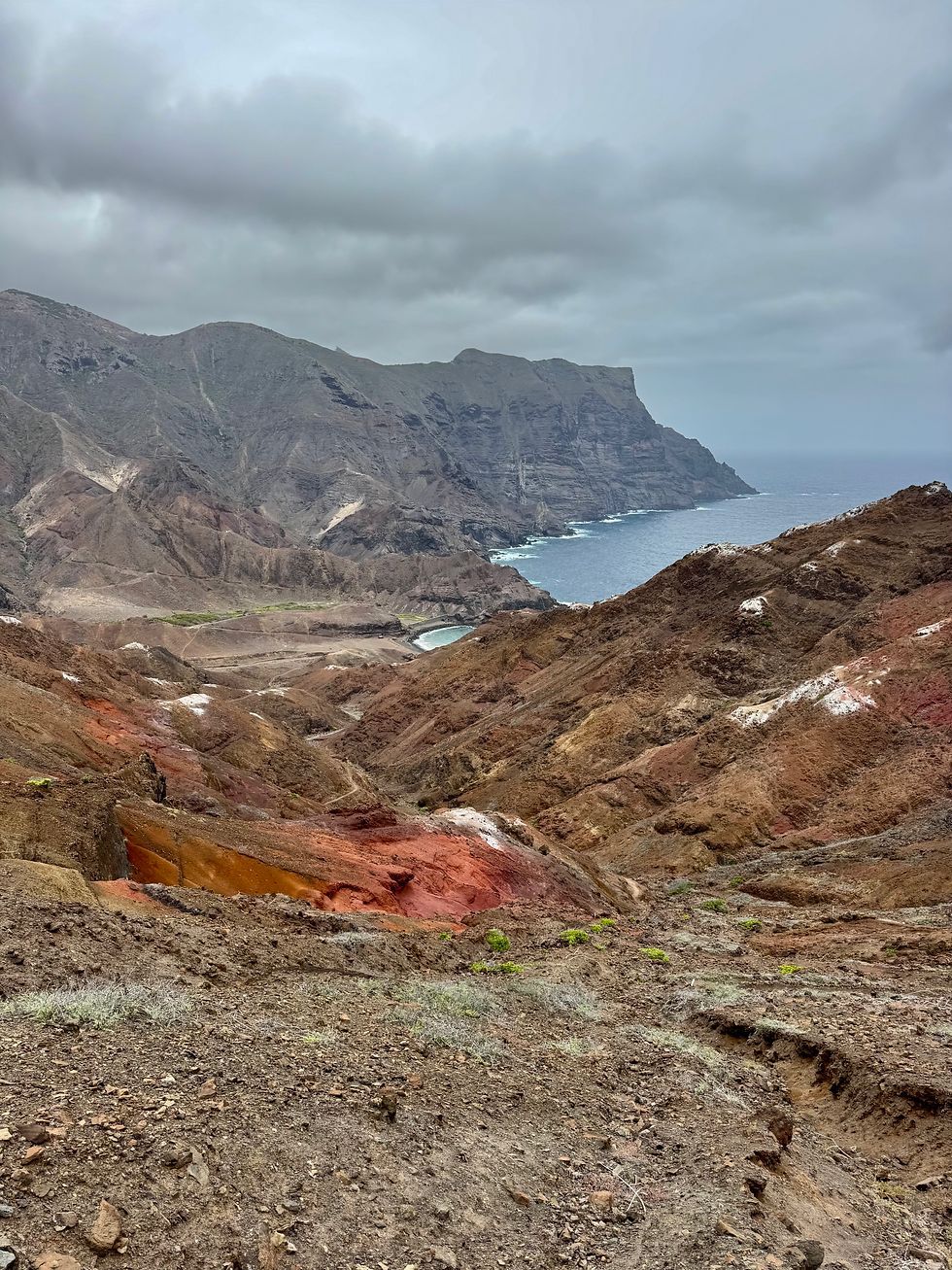
Stark, barren, volcanic Mars-like landscape with hardly a plant, with much of it overlooking sweeping views of the navy blue ocean. As we climb higher, the footing is loose rock, a bit slippery in some areas, with drop offs (some quite far) along the side of the path. Dave’s old tennis shoes don’t have much grip and he keeps sliding. It’s a bit unnerving to me but he takes it all in stride. We run into white Masked Boobies nesting along the path. They squawk at Neil as he gently spooks them off with his walking stick to allow us to pass. The nests created by these birds dot the black rock, looking almost like snow along the peaks of the steep cliffs. They don’t use any sticks or debris to create a nest, but simply lay their eggs on the crushed rock and rest on them. They leave a large pattern of white paint-like material (poop?) radiating out from the center of the nest like rays of sunshine in a circular pattern. Maybe it helps them find the nest amongst all the black landscape? It takes us every bit of 2 hours to make it to the coastal cliff above Lott’s Wife’s Pond. There are a couple tattered, knotted ropes leading over the edge, out of sight and down the cliff to the water. Nope, we decide they look too dodgy to attempt. Neil opens the wooden box housing the stamp for this trail, which he presses into his St Helena hiking book. Dave and I stamp our hands, rest briefly and turn around to walk the two hours back to the trailhead. A somewhat unsettling hike, being a bit dangerous at points, but really worth the incredible views and other-worldly feeling of the experience.
The following day, we hike an equally beautiful path but the polar opposite of our previous hike. This time, Dave decides to duck out. Rob, Neil and I drive to the trailhead of the Southwest Point. This part of the island feels like a piece of the countryside around the French Alps.

Rolling green (rich, deeply lush green) pastures, steep hills in some areas, dotted with white sheep with black heads (local cross breed of black faced sheep according to Neil). Our hiking path takes us right through their pastures. Fortunately, they’re not the least bit interested in us. Along the trail, a tiny shack rests with a small fenced in area used to shear the sheeps’ wool. The wool has been left in big piles, blowing away in the wind. Neil tells us wool is too expensive now and has been phased out by cheaper synthetic materials. The sheep are shorn to prevent parasites from growing in their fleece. Seems like such a waste. We continue on, hiking through forested areas, fields of flowers, a couple small barns along the way. Wild Calla lilies spring up in the forests, but also in the open fields.

The end of the path leads up a rock bald to a steep incline and then a large plateau filled with green grasses and yellow flowers. We eventually reach the point which overlooks the ocean. We’re on a high cliff with steep drop offs down to the crashing waves below. The lighting is dramatic. Looking out over the ocean, the sky is mostly overcast, silvery clouds with streams of sunshine passing through down to the sea below. The ocean is reflecting and almost mirroring the silvery clouds above. It’s beautiful and vast and shimmering. Hard to put adequately into words.

We complete the walk with a trail stamp to Neil’s book and our arms.
Thursday, October 23rd is Dave’s birthday. He says he doesn’t want us to do anything for him, but it’s already too late. I found balloons and a cheesy birthday banner in one of the stores. The restaurants here aren’t really anything special, so Rob grills filet mignon and I make the accompaniments, along with a chocolate cake. Earlier, Rob and I searched in town for a decent pair of hiking boots for Dave, but they were too small. Fortunately, he found a pair of athletic shoes in exchange for the boots.
On Friday, Alice and Andy invite us to join them at Danny’s for a special Tapas Tasting menu. Beforehand, they join us on Jolie for a sundowner. Andy brings along his fiddle. He is quite an accomplished musician and proceeds to educate us on traditional Scottish music - jigs, reels and waltzes. Their life in Orkney, Scotland sounds lovely. The town has many traditional get togethers and dances where he plays. Apparently, the young people still embrace these old traditions, along with their elders. As they describe it, I feel sad we don’t have any of these kinds of traditions where the whole town enjoys being part of it together.
We develop our own little tradition of visiting the St Helena Coffee Shop each morning for breakfast. The chef bakes wonderful, soft bread rolls for breakfast sandwiches and delectable cinnamon rolls on Sunday mornings. Then, we venture forth to see if any of the several, small grocery stores have fresh produce, bread, cheese or other items we could use for provisioning the boat. We’re aware of not depleting their supplies too much because this is what the local people need to cover themselves for the next 6 weeks. For several days, we make the rounds of stores for provisioning and perform boats chores. On our last night, we meet Andy and Alice for dinner at the fanciest hotel in town, the Mantis Hotel. Food is okay, but company is great. Enjoyed hearing stories and history of Scotland.
The following morning, a last ditch effort to find provisions. We score some eggs and tangerines!! Back to the boat for meal planning/prep for the passage while the guys work on preparing the lines. We depart around noon on Wednesday for the 1800 mile ocean voyage to Fernando de Noronha Island, off the north east coast of Brazil. Fair weather should guide us along this journey. At the same time, our thoughts are with the people of Jamaica as they’re getting hit with a Cat 5 hurricane. The range of weather, so breathtakingly beautiful to ruthlessly catastrophic. We have come to greatly respect it.


Comments